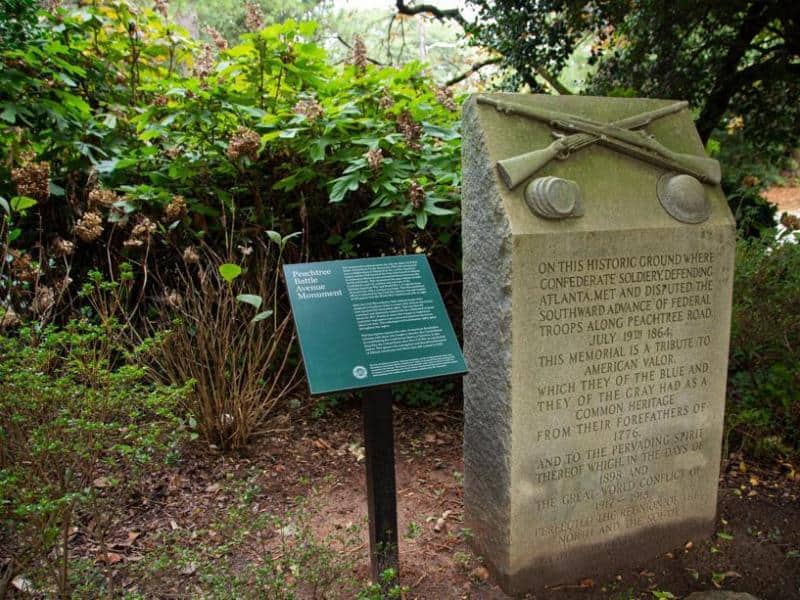
Following violence in Charlottesville, Virginia, in August 2017, then-Atlanta Mayor Kasim Reed announced the formation of an advisory committee. The Advisory Committee on City of Atlanta Street Names and Monuments Associated with the Confederacy was co-chaired by Atlanta History Center CEO Sheffield Hale and Center for Civil and Human Rights CEO Derreck Kayongo. It was tasked with making recommendations for a variety of monuments on city property and street names throughout Atlanta. Members of the advisory committee were appointed by both Mayor Reed and the Atlanta City Council.
The committee had four public meetings to discuss the future of Confederate monuments and street names and released a full report outlining research and recommendations.
Research.
City of Atlanta committee staff conducted research on all street names under consideration, working to identify, when possible, the origin of the street name. Atlanta History Center staff, meanwhile, researched the monuments under consideration using a variety of archival and online sources. The monument interpretation template was used as a guide. City staff conducted additional research on the civic organizations that commissioned the various monuments as well as legal considerations facing the City. All this research was presented by city staff at the advisory committee meetings, which were open to the public. A summary of the research is in the committee’s full report.
Public comment.
Each meeting began with a public comment period so that interested community members could express their thoughts and opinions. Meetings were televised for anyone unable to attend in person. Public comment was also accepted through a City email address; these comments were distributed to members of the committee and posted online by City staff prior to the final meeting.
Recommendations.
A summary of the recommendations of the committee is in the full report. In summary, the committee recommended contextualizing two monuments, removing two monuments to City storage, altering the street renaming process, and renaming certain streets immediately.
Implementation of the recommendations was delegated to a City Council subcommittee in July 2018 consisting of Council members Natalyn Archibong, Michael Julian Bond, and Carla Smith. The first recommendation to be implemented was changing the street name Confederate Avenue, formal consideration of which by the City Council began in August 2018. The renaming was approved by legislation passed by the full Council on October 1, 2018 and signed by Mayor Keisha Lance Bottoms on October 3, 2018.
Grassroots activists had been advocating for this change prior to the formation of the Advisory Committee and successfully canvassed the neighborhood to get the required approval of street residents. In coordination with Council member Carla Smith, the neighborhood collectively decided to rename the street United Avenue.
Contextualization.
State law O.C.G.A. § 50-3-1 barred the recommended removal of the Peace Monument in Piedmont Park and the Peachtree Battle Avenue monument. The City Council subcommittee opted to contextualize these two monuments instead. Atlanta History Center worked with the City to develop outdoor exhibition panels for these two monuments.
After conducting extensive research, Atlanta History Center staff drafted several pages of historical information that could be discussed in the contextualization panels. Staff then reworked this information into two outdoor exhibition panels for the Peace Monument and one outdoor exhibition panel for Peachtree Battle Avenue monument. These exhibition panels pay special attention the Reconciliation movement, the sentiments of which spurred the creation of both monuments.
While the Reconciliation movement aimed to unite North and South following the Civil War, this reunion coincided with the implementation of segregation laws that revived the pre-Civil War social order of white political and social dominance. Both monuments describe the Reconciliation movement in the spirit of “national fraternity” or call the reunion “perfected.” This language ignores the cause of the Civil War and essentially says that segregation, which denied civil and social rights to millions of Americans, was part of a perfect union. Text for the exhibition panels was carefully reviewed and edited by staff experts and presented to the City Council subcommittee in draft form in October 2018. A final draft followed in January 2019 that also included the design, mock-ups, and images for the panels.
Two other monuments, the Lion of Atlanta and the Confederate Obelisk in Oakland Cemetery, were originally recommended for contextualization by the Advisory Committee, since they were part of an early memorialization movement of the 1870s. This earlier movement focused on mourning loss of life with monuments usually placed within cemeteries. The obelisk stands in the middle of the Confederate section of the cemetery and includes the simple inscription “Our Confederate Dead,” while the Lion of Atlanta serves as a tombstone for 3,000 unknown Confederate dead.
The Historic Oakland Foundation, along with assistance from independent scholars as well as scholars from Kennesaw State University and Georgia State University, developed contextualization panels for these two cemetery monuments. These monuments were already part of the cemetery’s walking tours, so these panels provide further opportunities to engage interested visitors.
All finalized panels were approved by the Atlanta City Council subcommittee in May 2019 and were installed August 2, 2019. Funding for the fabrication of all panels was provided by Atlanta History Center.
Peace Monument panels can be viewed here.
In 2021, the Lion of the Confederacy statue at Oakland Cemetery was removed due to repeated vandalism.
Timeline.
August 12, 2017
Violence in Charlottesville, Virginia provokes a nationwide reexamination of Confederate monuments and symbolism.
September 14, 2017
Resolution creates Advisory Committee on City of Atlanta Street Names and Monuments Associated with the Confederacy approved by City Council and Mayor. The Advisory Committee has eleven members, five of which are appointed by City Council and six of which are appointed by the Mayor.
October 18, 2017
First meeting of the committee, Atlanta History Center CEO Sheffield Hale and Center for Civil and Human Rights CEO Derreck Kayongo elected co-chairs
November 1, 2017
Second committee meeting
November 8, 2017
Third committee meeting
November 13, 2017
Final committee meeting, recommendations adopted
November 20, 2017
Finalized report transmitted to City of Atlanta
January 2, 2018
Newly elected City Council members, City Council President, and Mayor begin terms.
July 2018
City Council President Felicia Moore appoints a 3-council member subcommittee to implement recommendations, which included Council members Natalyn Archibong, Michael Julian Bond, and Carla Smith.
August 2018
Formal consideration of changing the name of Confederate Avenue begins.
September 20, 2018
Meeting of the City Council subcommittee to discuss contextualization of Confederate monuments.
October 1, 2018
Legislation to change Confederate Avenue to United Avenue approved by Atlanta City Council.
October 3, 2018
Legislation to change Confederate Avenue to United Avenue signed by Mayor Keisha Lance Bottoms. Confederate Avenue street signs are replaced with United Avenue street signs throughout the fall.
October 17, 2018
Meeting of the City Council subcommittee to discuss implementing other recommendations of the Advisory Committee. Draft contextualization text is presented by Atlanta History Center and Oakland Cemetery. City staff present research on street names.
November–December, 2018
Atlanta History Center staff draft contextualization language for Peace Monument and Peachtree Battle Avenue monument for final approval.
January 11, 2019
Atlanta History Center submits renderings and mock-ups of exhibition panels for review and approval by City Council subcommittee.
January 21, 2019
Ceremony officially celebrates the new United Avenue.
March 30, 2019
Georgia Legislature votes to increase protections for monuments. This law increased fines and penalties of vandalism of any monument, as well as preventing removal or obscuring of monuments. Contextualization was not impeded by this new law.
April 26, 2019
Governor Brian Kemp signs monument legislation, with an immediate effective date.
May 20, 2019
Atlanta City Council approves legislation to contextualize Peace Monument, Peachtree Battle Avenue monument, Lion of Atlanta, and the Confederate Obelisk.
August 2, 2019
Exhibition panels installed at Peace Monument and Peachtree Battle Avenue monument.
Example actions. In states that prohibit removal.
States with laws protecting Confederate Monuments include Alabama, Georgia, Mississippi, North Carolina, South Carolina, Tennessee. More information about these laws can be found here.
The below at-a-glance examples represent a few ways that cities and universities within these 6 states that prohibit removal have chosen to address the Confederate monument controversy.
In October 2017, a Savannah city task force was convened to address the future of the Civil War Memorial in Forsyth Park. Standing over 50 feet tall, the monument consisted of a large sandstone shaft topped with a bronze statue of a Confederate soldier. It was further accompanied by two nearby busts of Confederate officers Lafayette McLaws and Francis S. Bartow.
In February 2018, the task force released its report, including recommendations such as renaming the structure from the “Confederate Monument” to the “Civil War Memorial” and relocating the McLaws and Bartow busts to Savannah’s Laurel Grove North Cemetery, where the two men are buried.
These recommendations were unanimously passed by the Savannah City Council. However, the city has been unable to relocate the McLaws and Bartow busts due to a conflict with Georgia law. Strengthened in 2019, state law O.C.G.A. § 50-3-1 broadly forbids the removal, concealment, or relocation of any publicly owned monument, further specifying that the structures should not be moved to museums, cemeteries, or mausoleums unless originally placed at such locations.
After a string of vandalisms, the task force released an updated report in October 2020 which recommended the busts be moved to temporary storage for their protection. However, the matter has not been further pursued, and as of 2026, the McLaws and Bartow busts remain in their place in Forsyth Park.
In 2017, locals of Decatur, Georgia began calling for the removal of the city’s Confederate monument, a 30-foot stone obelisk located in front of the Historic DeKalb County Courthouse. The movement was supported by local organizations, such as the Beacon Hill Black Alliance for Human Rights and Hate Free Decatur.
After multiple years of protests and unrest, the monument was removed by a court order in June 2020. The removal order cited the monument’s status as a public nuisance with DeKalb County Judge Clarence Seeliger writing, “In short, the Confederate obelisk has become an increasingly frequent target of graffiti and vandalism, a figurative lightning rod for friction among citizens, and a potential catastrophe that could happen at any time if individuals attempt to forcibly remove or destroy it.” Since the purpose of the removal was to “abate a public nuisance and protect the obelisk” as opposed to preventing its public display, the order did not directly challenge Georgia state law protecting historical monuments.
In August 2024, the city erected the John Lewis Memorial to honor the recently passed Civil Rights leader, placing the statue where the Confederate monument had once stood.
For more information, see out: “The Monument That Sparked a Movement,” DeKalb History Center, March 30, 2021.
In March 2016, the University of Mississippi erected a plaque to contextualize its on-campus Confederate monument, a tall marble shaft topped with a statue of a Confederate soldier. A group of faculty were unhappy with the way the plaque discussed the history of the Civil War and, using resources created by the Atlanta History Center, pushed the administration to update it to better address the history of slavery and the Lost Cause narrative. The plaque was rewritten and reinstalled in October 2016, along with the publication of online contextualization resources.
In March 2019, the Ole Miss Student Government voted unanimously to move the Confederate statue from its prominent spot near the university’s main administration building to a secluded cemetery on campus.
In July 2020, the statue was finally relocated to the university’s Civil War cemetery, which holds a number of Confederate soldiers killed at the Battle of Shiloh.
In August 2020, the university constructed a barrier to partially block view of the monument, after student athletes complained that its location on a hill made the monument visible from the football practice field.
During an August 2018 rally, demonstrators at the University of North Carolina pulled down a Confederate statue known as “Silent Sam.” The rally was held in support of Maya Little, a UNC doctoral student facing criminal charges for previously vandalizing the monument. Located near the main entrance of the university, the 17-foot-tall monument included a stone pedestal topped with a bronze statue of a Confederate soldier. After being torn down, the statue was moved into temporary storage while the university considered its next steps.
In December 2018, the university administration proposed the construction of a $5.3 million campus museum to house the statue and other university artifacts. However, this proposal was rejected by the state’s University System Board of Governors.
In January 2019, UNC removed the monument’s pedestal, which had remained at the site, citing continued safety concerns.
In November 2019, the Sons of Confederate Veterans (SCV) filed a lawsuit against the university regarding the monument. As part of a settlement, UNC agreed to give the statue to the SCV along with a $2.5 million fund for its preservation and display.
However, in February 2020, a judge voided this settlement, arguing that the SCV did not have standing to bring the original lawsuit. As of 2026, the monument remains in storage with the university.
In August 2018, the North Carolina Historical Commission released a list of recommendations regarding the Confederate monuments at the State Capitol in Raleigh. The monuments in question were: 1.) the 75-foot-tall State Confederate Monument, consisting of a granite shaft topped with a bronze statue of a Confederate soldier and flanked by two additional soldier statues, 2.) the Confederate Women’s Monument, including a statue of an older woman reading to a young boy and 3.) a statue of Henry Lawson Wyatt– the first soldier from North Carolina to die in battle during the Civil War. While the committee declared the monuments to be an “over-representation and over-memorialization” of the Civil War era, it determined that it was not at liberty to recommend their removal because of a 2015 North Carolina law which protects memorials on public land. However, the commission did vote to add contextualizing signage to the monuments as well as to pursue an additional monument honoring the contributions of African Americans in North Carolina.
In June 2020, protestors pulled down two bronze statues of Confederate soldiers from the North Carolina State Confederate Monument. Soon after this event, Governor Roy Cooper ordered the removal of all Confederate monuments from the State Capitol grounds to protect public safety.
While talks have continued about the possibility of installing an African American monument at the State Capitol, no concrete plans have been put in place as of 2026.
In December 2017, the City of Memphis sold two parks containing Confederate monuments to Memphis Greenspace, a private nonprofit. This sale allowed for the removal of the monuments, including a statue of Nathan Bedford Forrest, a statue of Jefferson Davis, and a bust of James Mathis—bypassing a Tennessee law protecting memorials on public land.
In December 2019, the Sons of Confederate Veterans (SCV) received ownership of the monuments as part of a legal settlement. While the group announced plans to display the statues elsewhere, they appear to still be held in an undisclosed storage facility as of 2026. The monuments will not be re-erected in either of the Memphis parks.
In June 2021, the remains of Nathan Bedford Forrest and his wife, Mary Ann Montgomery, were exhumed from Memphis’s Medical District Park (formerly Forrest Park) where they had lain near his former statue. The remains were then relocated to the National Confederate Museum in Columbia, Tennessee.
In March 2020, the Virginia General Assembly passed a law that would allow local governing bodies to remove historical monuments through a structured administrative process, repealing an earlier state law which protected all public war memorials.
In June 2020, during national outrage at the police killing of George Floyd, protestors in Richmond tore down a statue of Jefferson Davis, one of five Confederate monuments lining the city’s Monument Avenue.
As demonstrators continued calling for the removal of the avenue’s other statues, Richmond Mayor Levar Stoney used his emergency powers to order the immediate removal of all Confederate monuments in the city. While he received some criticism for using an emergency order instead of employing the new state law, Stoney expressed concern that the lengthy administrative process required by the statute would facilitate continued unrest in the city and further public safety concerns.
In July 2020, the city of Richmond removed the monuments for Stonewall Jackson, J.E.B. Stuart, and Matthew Fontaine Maury as well as the remainder of the Jefferson Davis monument. However, the city’s Robert E. Lee statue proved more difficult to remove because of a pending lawsuit. After a lengthy legal battle, the Virginia Supreme Court ruled that the city could proceed with the removal, which took place in September 2021.
In 2025, the Jefferson Davis and Matthew Fontaine Maury statues were loaned to the Los Angelos Museum of Contemporary Art for an exhibition titled Monuments, which presented decommissioned Confederate monuments alongside contemporary works to address the United States’ complex racial history.
Resources. Toolkit.
-
Projects & Initiatives
A toolkit designed to help communities address Confederate monuments in their midst.
-
Confederate Monument Interpretation Guide
Confederate monuments were built across the United States, including in states that were not part of the Confederacy. Even today, new monuments are being erected, while others are being removed.
-
Confederate Monument Interpretation Guide
Confederate Monument Interpretation Guide media coverage.
-
Confederate Monument Interpretation Guide
This research template provides a guide for conducting research on individual monuments in local communities.