The Grace Towns Hamilton papers collection was donated to the Atlanta History Center in 1986. Grace Towns Hamilton was the first African American woman elected to the Georgia General Assembly. When she took office in 1965, she was one of six black elected officials to enter the House of Representatives since the end of Reconstruction in 1877. An outspoken citizen, Hamilton served as the executive director of the Atlanta Urban League for eighteen years. One of the first women to hold the position, she bucked tradition and chose to wage intensive campaigns against segregation, healthcare inequalities, and educational disparities across Atlanta.
During her eighteen-year career as a Georgia legislator, she worked to expand representation of Black citizens in local and state government. When she left office, the representation of African Americans on the Atlanta City Council was commensurate with their proportion of the population. Heralded for her promotion of interracial cooperation, she is known as “the most effective woman legislature [Georgia] has ever had.”
Reflections from the Processing Archivist
It was the second collection I was assigned to since I started working here at the Atlanta History Center as the Processing Archivist. My job was to reorganize and add detail to the existing materials, and to include additional material donated in subsequent years. This consisted of arranging, rehousing, describing, labeling, and preserving approximately 77 linear feet (nearly 200 boxes) of manuscript material that Hamilton collected throughout her life.
The materials document Hamilton’s personal and family life, her groundbreaking career in and outside of politics, and her deep connections to major Atlanta institutions such as the Atlanta Urban League as well as historically Black colleges and universities including Spelman College and Clark Atlanta University. The bulk of the collection includes legislative documents that either she worked on or obtained while serving as the first Black woman elected to the Georgia General Assembly. The collection also contains material extensively documenting Hamilton’s work and commitment to addressing issues concerning the African American community in Atlanta, Georgia, especially in regard to health, housing, voter registration, and political representation.
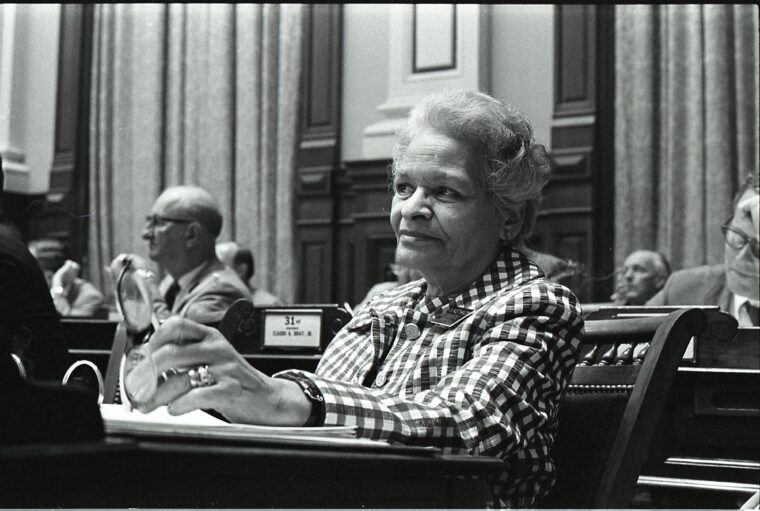
I found this collection to be impressive for the breadth of information that Hamilton preserved throughout her life as I was most fascinated with the number of newspaper clippings that she kept which often highlighted her political career. The collection is also notable for the substantial body of correspondence that reveals her relationships with constituents, community leaders, and prominent Civil Rights figures, including Dr. Martin Luther King Jr. Together, these materials provide insight into Hamilton’s role as a public servant and advocate during a pivotal period in Atlanta and Georgia’s political history from the 1960s through the 1980s.
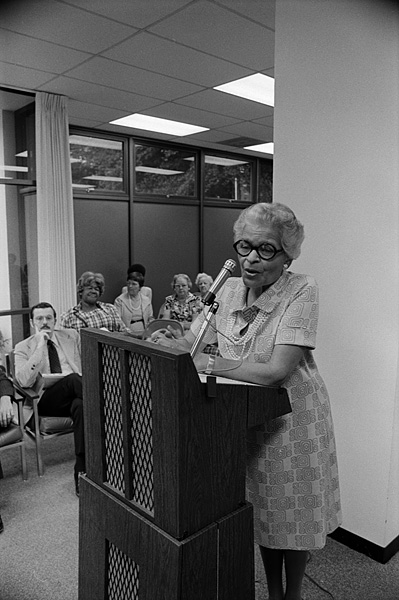
My work to organize Hamilton’s collection resulted in a finding aid that includes a comprehensive, folder-level inventory, and descriptions for each series so that researchers can use it as a guide to use, understand, and navigate this collection with ease. I am extremely glad to be the one to finally share this collection with the public since it consists of not only my contributions but it also reflects the hard work and dedication of so many others here at the Kenan Research Center.
This collection is free and available for research through the Kenan Research Center. To make an appointment, please contact reference@atlantahistorycenter.com.